Monthly Archives: August 2010

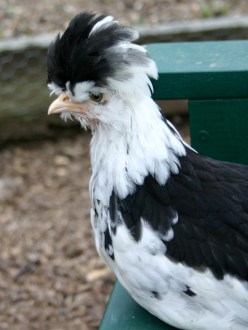
Why, Ms. Cochin—without your feathers, you’re beautiful!

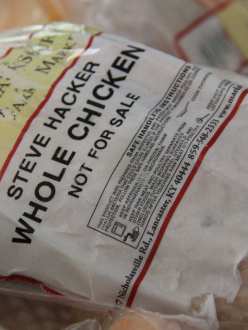
Monday’s trip to and from Lancaster was much more pleasant than the last one. Reasons included a daylight drive, a sedan instead of a truck, a working radio, and a noticeable lack of squawking, feathers or fecal smells. After a sunny drive through central Kentucky, Steve indulged in a brief walk on Centre College’s campus (anyone know what happened to the little marker that was supposedly positioned at Kentucky’s geographic center?), then drove a few minutes further to pick up the birds. The Marksbury Farm folk had everything ready—the chickens nicely sealed and labeled, brought in from the big air-chilled room Steve toured Saturday and placed in the office refrigerator. Steve stowed the chickens in two coolers, iced them down at the nearby BP station, then returned home.

"Private label"

Bagged and tagged, the chickens really have no relationship to the creatures who once roamed our yard. We may, at some point, find a particular scar or marking that identifies “Bob” or “Scabby,” but most of the birds just look like your local market selection. Before we stored them in our freezers, the birds looked wonderful—healthy skin, pink flesh, and bits of fat poking out from various places. Some are big, some are small, but all will find a place of honor and use in our kitchen this Winter. We look forward to sharing them, as we look forward to sharing more eggs from the new flock this Summer.

3 Comments

Filed under Chickens, Food

Good night, ladies.

One of the Bobs, with Scabby and a Faverolle in background.

Dawn on Saturday found Steve rattling by his alma mater with a truckload of sleepy, mildly-protesting chickens, on his way to Marksbury Farm Market’s new Garrard County processing facility. As we neared Gourmandistan’s temporary relocation to Gascony, it was deemed time to retire the flock. We (OK, Steve) had winnowed a few from the flock earlier this year—but after dealing with four in one day, Steve decided he was no match for nineteen.

Michelle was drowsily dragged from her bed at 4:30 a.m., assisting Steve as he grabbed the hens and placed them in a couple of cages. (The rooster went into a old cardboard cat carrier, to spare the hens certain indignities on their final journey). Blankets thrown over the still-snoozing hens, Steve set off in darkness for Lancaster, a small town in central Kentucky.

The processing had been postponed a couple of times, as Marksbury Farm is just beginning operations, and the usual start-up problems occurred. Steve, who (somewhat ashamedly) counts a giant poultry agribusiness as a former client and (in some sort of simultaneous karmic payback) was forced to take the dreaded “factory tour,” has previous experience with processing lines. He was very impressed with Marksbury Farm’s operation, which claims a “commitment to sustainable, humane, and natural production methods.” Everything seemed spotless—which, granted, may have been in part because no chicken had yet gone through the line. But unlike Steve’s Upton Sinclair Jungle-esque experience in Indiana, the workers seemed lively, motivated and excited about their new venture in more humane processing. Since yet another opening day glitch had halted the expected 7:00 a.m. start time, Steve left the chickens in a few crates alongside a few hundred more chickens scheduled for that morning. The hens seemed much calmer than the Marksbury people, who were determinedly talking of circulator pumps and V-chutes as Steve drove off toward home.

As our farmer friend Jim Fiedler says of his pigs and cattle, we feel our flock really only had “one bad day.” Many of these hens spent 4-½ years happily bug-eating, dust-bathing and generally ruining what was once our garden, delighting in daily heaps of Gourmandistan leftovers and leavings. While the younger group of Faverolles and Wyandottes never really bonded with us, “The Bobs,” “Ugly” and “Scabby” may have actually appreciated our treatment. (At least, the one Bob Steve nursed back to health with antibiotics and Band-Aids after an owl attack may have.)

It’s been quite an odd past few days in Gourmandistan. Not hearing any Chewbacca-like noises coming from the chicken yard. Seeing a larger-than-usual kitchen compost pile now that apple cores and watermelon rinds are no longer easily disposed of. And having the strange realization that nothing, absolutely nothing, is making us get up at the break of dawn, and be home by shortly after dark. This oddness won’t last. We’ve already arranged for some laying hens to keep us in a few eggs this Winter, and plan to start a new flock from baby chicks in early Spring. But for now, Gourmandistan is poultry-free—until some new birds arrive to run our lives, enjoy running our grounds, and eventually have that one bad day.

This slideshow requires JavaScript.

15 Comments

Filed under Chickens, Food

24-hour breakfast people

One of the nice things about having chickens in the backyard is that we rarely run out of eggs—which means we’re always ready for breakfast. (We’ll have fewer eggs than usual this Winter, but that’s best told in another post.) “Breakfast” isn’t necessarily a morning thing in Gourmandistan. Since we try to have Steve’s home-cured bacon around along with fresh eggs, breakfast can be the perfect answer to “What’s for dinner?,” especially if we’ve been too busy/frazzled to plan ahead. Of course, Michelle prefers that the evening meal still have some elegance, even if we’re being simple. (Steve, if left alone, will occasionally just eat a plate of scrambled—but he has trouble restraining his bachelor mentality.) One way Michelle has helped us enjoy breakfast as dinner is by deciphering The Zuni Cafe Cookbook‘s somewhat inscrutable instructions (what does “just oversaturate” mean, Judy Rodgers?) for “Fried Eggs in Bread Crumbs.” It’s a simple, tasty way to dress up a batch of eggs—and conveniently comes with its own toast.

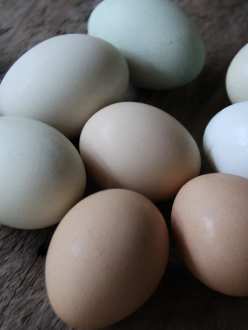
You don't see yolks this color in supermarket eggs.

FRIED EGGS in BREAD CRUMBS

(adapted, only slightly, from Judy Rodgers’ The Zuni Cafe Cookbook)

For 1 serving:

3 TB. bread crumbs
Salt & pepper
About 2 TB. olive oil
Coarsely chopped fresh rosemary
2 eggs
About 1 tsp. sherry vinegar

Season the crumbs with salt, pepper and rosemary, then drizzle some of the oil over (“to just oversaturate them,” whatever that means).

Place the crumbs in a nonstick skillet over medium heat.  Warm the crumbs through, tossing.

Make a couple of indentations in the crumbs, and pour remaining olive oil into them.  Crack eggs into the indentations.  Cook the eggs as you like.  (We prefer over medium.)  Plate eggs and crumbs, and drizzle vinegar over.

5 Comments

Filed under Chickens, Cooking, Food, Recipes, Vegetarian

What a way to watermelon

Both our farm shares have provided watermelons in the past few weeks, which hasn’t stopped Steve from buying them at our local markets. According to many farmers we’ve talked to, the staggering summer heat has affected many crops—but the melons seem to take the weather well. Noting Michelle’s apprehension at our growing mound of melons, Steve offered to make her some agua fresca.

Jeeves likes watermelon, too.

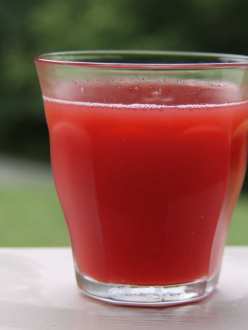
We first encountered this delicious drink years ago at the Mayan Gypsy, a marvelous restaurant featuring Bruce Ucán’s evocations of and innovations on Yucatan cuisine.  We then discovered the “home version” in Alice Waters’ Chez Panisse Fruit. Like many of Alice’s recipes, it’s devastatingly simple—all you need is a blender, sugar, water, limes and, of course, watermelon. Agua fresca (“fresh water”) is cool, sweet and satisfying. It’s an easy, delicious way to beat the summer heat—and take care of any surplus melons you may have around.

WATERMELON AGUA FRESCA

(from Alice Waters’ Chez Panisse Fruit)

Cut 7 pounds of watermelon into chunks, discarding the rind.  In batches, liquefy the melon in a blender, pulsing in short bursts to avoid grinding the seeds.  Strain, pushing pulp through the sieve.  Thin juice with about 2 cups water and sweeten with 1/4 cup sugar.  Add about 1-1/2 TB lime juice.  Chill.

1 Comment

Filed under Cooking, Food, Vegetarian

Remembrance of eggplants past

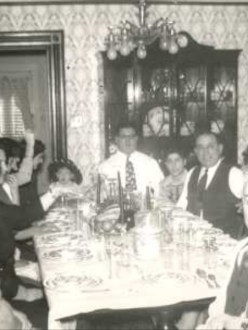
DeMarzo Family Dinner – Orange, NJ

Gourmandistan likes oral histories, like those generated by the WPA Writers’ Project (something we wish was still around—are you listening, government recovery people?). We think it’s lovely when individuals get a chance to share their ideas of the times they lived through. (Steve, especially, looks forward to lecturing people about life in Middle American Suburbia, if he can only get them to stop watching “Leave it to Beaver,” “My Three Sons” and just about any other show on TV Land.) But however much we want to travel the nostalgia path, we must remember that the map is not always accurate. Recently, Steve discovered many of his mother’s cues to his Italian heritage are not quite definitively “Italian” as he thought. The family’s pronunciation of capicola (“gabbagool”) follows a Neapolitan tradition, but Steve thought “struvela” was the name for the honey-dipped Christmas treat struffoli, showing how Neapolitan pronunciation changes from Mechanic Street in Orange, NJ to Graymoor in Louisville, KY. In another example, Steve’s mother has occasionally called him a “scorchamende” (her best phonetic guess at the spelling). She says it’s a word she picked up from her Italian-speaking grandmother that means “scamp” or “imp.” This word, as far as Steve can tell, does not exist in Italian. He has found the similar-syllabled scassacazzo, which is Italian for “pain in the ass.” (This word would apply to some, but not all, of the times Steve has been referred to as a “scorchamende.”)

Steve started to wonder how “authentic” his family’s style of eggplant parmigiana really is. As Summer reaches its peak, we’ve been busily sourcing paste tomatoes and preparing and freezing batches of sauce for Winter pizzas and spaghetti dinners. Steve traveled to Hazelfield Farm for Raphe and Teresa’s sauce tomatoes, and was gifted a few eggplants while he was there—so as soon as we had some mozzarella, we had no excuse for not making parmigiana. As our labors began with thinly slicing the eggplant and placing the slices on racks to dry, we began talking about how no other eggplant recipe we’ve seen calls for drying. Steve recalled his mother using a pasta board instead of racks, and Michelle suggested he call home to see if his memory was correct (“It will make good blog material!”). Steve’s mom said yes, she used a pasta board and paper towels to dry her eggplant—then recalled how her grandmother used to put her board across a hedge in her back yard, letting her eggplant dry in the sun before breading and frying.

Great-grandmother Filomena Belfatto on Mechanic Street

Whether you use a rack, board or the sun, we must insist that drying the eggplant is definitely the reason Mechanic Street’s idiosyncratic parmigiana rises above the rest. The slices of fried, dried eggplant reconstitute themselves with tomato sauce as they bake, melding with the rest of the ingredients into something so good we wish we had it more often. But our ties to seasonality (and its construction being a scassacazzo) make parmigiana something we have only once or twice a year. Take our word for it—you’ve never had a better parmigiana.

UPDATE: Steve spoke with his mother again, who had contacted their cousin Rosanne for a bit more word sleuthing. They figured that “scorchamende” is the transliteration of a Neapolitan pronunciation of scostumatezza, meaning “debauched” or “ill-bred.” Steve’s mother assures him that she only called him this (which Steve remembers hearing with some frequency) when he was being “amusingly exasperating.”

DeMARZO FAMILY EGGPLANT PARMESAN

Slice eggplant very thin and dry overnight.  If in a hurry, you can dry in a dehydrator.

After drying, put the slices through the traditional 3-bowl fryer prep:  dip in flour, then in beaten egg, and finally in seasoned bread crumbs.

Fry breaded slices in olive oil, and drain.

Layer eggplant with tomato sauce, mozzarella, Parmesan and chopped basil and parsley—ending, of course, with a layer of cheese.

Bake in a medium (350 degree) oven for a half hour or so.

3 Comments

Filed under Cooking, Food, Recipes, Vegetarian