Monthly Archives: December 2011

A small, citrusy step away from the treacle.

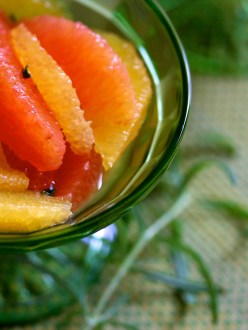
It’s almost the end of the holidays, and we’re starting to be just a bit sick of sweet. While eating our way through what remains of Michelle’s cookie cavalcade (reduced by gifts, get-togethers and Steve’s occasional late-night rustling), we started to think of slightly less sugary finishes to our meals. We make this dish only occasionally, as it requires wonderful winter citrus and restaurant-level pith removal that is beyond Steve’s skill set to meet Michelle’s standards for fresh fruit consumption. Sweetened with honey and spiked with rosemary, it’s pretty simple to put together (unless you, like Michelle, are relentlessly pithaphobic). And it’s more refreshing, herby, earthy and tart than it is sweet.

At a recent dinner with some longtime friends, it made an excellent counterpoint to an assortment of Michelle’s cookies. After all, while we like many may have some “healthier” resolutions and plans, it’s not quite the new year yet.

CITRUS WITH ROSEMARY HONEY

(adapted from Judy Rodgers’ The Zuni Cafe Cookbook) (serves 4)

1/4 c. honey
4 tsp. water
a dozen or so rosemary leaves
4-6 oranges, preferably of different colors (you can also substitute one or two oranges with a ruby grapefruit)
 

Place honey and water in a tiny saucepan.  Chop rosemary leaves and add to pan.  Heat over low heat until warmed but not boiling.  Set aside.

Section citrus as described here.  Make segments about the same size.  If using large fruit, such as grapefruit, you will want to divide the segments into smaller pieces.  Place fruit segments, alternating colors, in 4 small bowls. Squeeze juice from remaining pulp into a bowl and pour over the fruit segments.  Can be prepared ahead of time, covered and refrigerated.

Just before serving, drizzle cooled honey and rosemary over fruit segments.


12 Comments

Filed under Cooking, Food, Recipes, Vegetarian

Linzer Hearts still beating after all these years

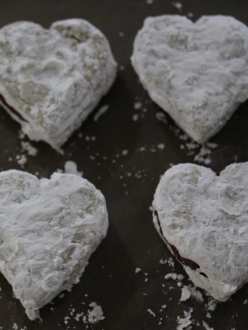
Michelle’s spattered and battered paperback edition of The Silver Palate Cookbook is full of notes, as during the Eighties it was one of our most-used volumes. We don’t turn to it much these days, as it seems a bit dated (Brie cheese baked in phyllo and a pound of butter, anyone?) and a bit embarrassing (why on earth did we note that baked garlic was “strange”?).  But we keep the volume on our bookshelves, in large part because of these marvelously nutty, buttery sweet delights that Michelle’s friend, Carla, pines for every Christmas.

Perhaps at another time we will return to the Silver Palate, reflecting on how much has changed since we had big hair, wore immense shoulder pads and were made to endure Huey Lewis & The News (although, come to think of it, we could probably still find all those things at the casino downriver).  While we still shun “The Heart of Rock & Roll,” we always welcome this delicious cookie—even after all these years.

LINZER HEARTS

(adapted from The Silver Palate Cookbook) (makes about 4 dozen)

3/4 lb. (3 sticks) unsalted butter, softened
1 c. confectioners’ sugar
1 egg, at room temperature
2-1/3 c. all purpose flour
2/3 c. cornstarch
2 c. finely grated walnuts
1 c. red raspberry preserves (seeds strained out)
extra confectioners’ sugar for rolling and dipping
 

Cream butter with 1 c. confectioners’ sugar until light and fluffy.  Add egg and beat a bit more.

Sift together flour and cornstarch.  Add to butter mixture and mix well.  Mix in walnuts.

Divide dough in half.  Form each half into a flattened circle.  Wrap in wax paper.  Chill in refrigerator for at least 4 hours.

Roll dough to 1/4″ thickness.  Cut out cookies with a small (approx. 1-1/2″) heart-shaped cutter.  Place on ungreased cookie sheets.  Chill in freezer until hard.  Re-roll remaining scraps as many times as you need to, using confectioners’ sugar rather than flour to keep from sticking.

Preheat oven to 325°.

Bake cookies for 10-15 minutes.  They should be only very lightly browned.  Remove and cool on a rack.

Match cookies into pairs that are about the same size and shape.  (If rolled to same thickness and properly chilled before baking there shouldn’t be too much variation.)

While still warm, hold a cookie in one hand and spread the under side with a thin layer of preserves, keeping a bit away from the edge.  Cover with another cookie (under side to preserves) and press together gently.  Repeat until all cookies are made into sandwiches.

Sift some confectioners’ sugar into a bowl.  Press the cookies, top and bottom, into the sugar to coat.

Merry Christmas, Carla!


13 Comments

Filed under Cooking, Food, Recipes, Vegetarian

The agony and the apricot-y

Once upon a time, when much younger and much more energetic, Michelle made cookies to share with friends and family for the holidays. Of course, Michelle being who she is, these cookies were very, very good—but also took up very, very much of her time. Within a few years she was spending virtually the entire month between Thanksgiving and Christmas obsessively thinking about cookies, making cookies, packaging cookies and distributing cookies to a growing number of people, constantly trying to outdo the last season’s gifts. (Alas, in those days, it never occurred to anyone to waste film on a photo of a cookie assortment so we have no visual record of it.)

Of course, simple human frailty, work demands and a finite amount of freezer space made this trajectory as unsustainable as the housing bubble, and the cookie-making crash saw the holiday cookie boxes stay unfilled for many years. This season, however, Michelle has quietly begun a new cycle, tackling as her first return her famed Ischler apricot sandwich cookies made from an old Maida Heatter recipe.

From the cookbook, long "borrowed" from Michelle's mom

It takes an astonishing amount of effort to produce even a few of these buttery-short almond delights, sweet with apricot jam filling and dipped in silky bittersweet chocolate.  In the old days, most were reserved for Michelle’s mother (and Steve, who is not, we are sad to say, above stealing).

Michelle plans again to give most of the Ischlers to her mother, but has been reviving the Christmas cookie tradition with a few more varieties, some old and some new. The sweet cookie stocks found before the turn of the century may never return to their dizzying heights, but the denizens of Gourmandistan (OK, mostly Steve, who cooks no cookies) see even this modest recovery as a very positive holiday development.

ISCHLER COOKIES

(adapted from Maida Heatter’s Book of Great Cookies) (makes somewhere between 25 and 50 sandwich cookies, depending on size)

8 oz. blanched almonds
2-1/4 c. sifted all-purpose flour
2/3 c. sugar
10 oz. (2-1/2 sticks) cold butter, cut into 1/2″ slices
1/2 to 3/4 c. apricot preserves
approx. 10 oz. bittersweet chocolate
1-1/2 TB vegetable shortening
 

Put almonds in food processor and grind to a fine powder, just short of turning into a butter.  Place ground almonds in a large mixing bowl.  Add flour and sugar and stir to mix.  Use a pastry blender to cut the butter into the dry ingredients until the mixture resembles a coarse meal.

Turn the dough out onto a smooth work surface.  Squeeze dough between your hands until it holds together.  Form into a ball, flatten it a bit and then break it—that is, use the heel of your hand to push off small pieces, smearing against the work surface until the butter is fully incorporated into the dry ingredients.  Form the dough into a ball again.

Divide the dough in half.  Form each half into a flat round disk on a piece of wax paper.  Place another sheet of wax paper over.  Use a rolling pin over the top paper to roll the dough 1/4″ thick.  Slide cookie sheets under the wax paper-enclosed flattened dough.  Transfer to the freezer (or place outside on a cold day).

Preheat oven to 350°.

When dough is firm, pull off wax paper.  Cut out using a 2″ to 2-1/2″ round cookie cutter.  Place cookies 1″ apart on ungreased cookie sheets, using a metal spatula if necessary.  If dough has warmed up, put back in the freezer for a bit to firm so cookies will hold their shape.

Reserve scraps and repeat process of rolling, cooling and cutting.

Bake cookies for 12-15 minutes, reversing the sheets front to back and top to bottom midway through.  The cookies, when done, will be lightly golden (not brown).  Remove with a spatula and cool on a wire rack.

Match up cooled cookies into pairs of equal sizes.

Strain preserves through a sieve or (lazier way) process in food processor.

Hold a cookie in one hand and spread the under side with a thin layer of preserves, keeping a bit away from the edge.  Cover with another cookie (under side to preserves) and press together gently.  Repeat until all cookies are made into sandwiches.

Melt chocolate and shortening over very low heat in a small pan.  Transfer to a small bowl.

Line a couple of cookie sheets with wax paper.  Dip cookie sandwiches into chocolate glaze until sides are about half covered.  Wipe edge of each sandwich against top of bowl to remove excess glaze.  Place on wax paper.  When all cookies are glazed, place cookie sheets in freezer or refrigerator to allow chocolate to set. When glaze is set, cookies can be removed and stored in a container, in layers separated by wax paper, in the freezer.

These cookies are best when served chilled or frozen.

18 Comments

Filed under Cooking, Food, Recipes, Vegetarian

An “au revoir/auf wiedersehen” to apples

Alsatian Apple Tart

Steve has probably purchased his last batch of local apples for the year, and since he snacks on several per day (there are many, many doctors out there, after all) he’ll soon be buying what he calls “crapples” at the grocery. Michelle, however, has higher standards, and refuses to cook with the flown- and trucked-in Braeburns, Fujis or sappy-sweet HoneyCrisps that Steve brings home. While that means Tarte Tatin and apple clafoutis must wait until next fall, Michelle recently managed to steal some fruit from Steve’s hoard and make an Alsatian apple tart.

Alsace is a land smack between Germany and France, and may be what Europe will look like if their monetary crisis fuses the two nations. We spent a month in Alsace in 2008, jumping back and forth between the former enemy countries.

We toured the militarily tragic sites (lines of old trenches and warnings of live ammo at Verdun, star-shaped forts on the Rhine, battle-scarred memorials in the Colmar Pocket).  But mostly we enjoyed the region’s majestically comic aspects (Hansi prints, assorted kitsch, Pfifferdaj in Ribeauvillé).

A land of perpetual Christmas villages, Alsace also has a mind-blowing array of tiny vintners producing delicious white wines.  Alsatians seemed to us quite proud of their dishes such as baeckeoffe, fleischnacka, Kugelhopf and flammekueche.  (We must admit, though, that we had just about enough choucroute and poulet au riesling in that month to last several lifetimes.)

While we (as usual) enjoyed touring the area markets, we were without an oven in our otherwise charming rental, so we never tested this tart within the (possibly still disputed) boundaries of Alsace-Lorraine. But as we say so long to apple season, we can savor this tart along with our memories of what has to be one of the oddest places we’ve ever visited.

ALSATIAN APPLE TART

(adapted from Susan Herrmann Loomis’ French Farm House Cookbook)

Pâte brisée, partially baked in a 10″ tart pan and cooled
2 large eggs
3/4 c. crème fraiche
1/4 c. heavy cream
1/4 c. white sugar
1/4 c. light brown sugar
1 tsp. vanilla
2 medium apples, peeled, cored and cut into very thin slices
1/4 t. ground cinnamon
1/3 c. walnuts, finely chopped
 

In a bowl, whisk together eggs, creams, sugars and vanilla.

Line the cooled pastry with apples, in a circular pattern.  Pour the filling mixture over.  Sprinkle with cinnamon, then with nuts.

Place tart on a baking sheet.  Bake for 25 to 30 minutes at 400°, until custard is set.  Cool on a wire rack.


10 Comments

Filed under Cooking, Food, France, Recipes